Tools and Data Resources
Disclaimer: The Securities Commission Malaysia and the Advisory Committee on Sustainability Reporting (ACSR) does not take responsibility and accepts no legal liability whatsoever arising from or connected to any content produced or owned by third parties. All information published are for general information and reference purposes only. The ACSR makes no warranties, expressed or implied, as to the completeness, reliability, suitability, or accuracy of the information contained here. The ACSR does not monitor or control the third-party content published on their website including subsequent changes made thereto. The list below is non-exhaustive and does not represent endorsement by the ACSR. Always ensure you identify data sources and platforms that are appropriate and relevant for your organisation’s needs for purposes of preparation of the sustainability report. It is advisable to seek the advice of a qualified professional before making any decisions on the preparation of the sustainability report.
Centralised Reporting and Scope 3 Emissions
The SEDG covers indicators that can be tracked and disclosed to measure ESG progress, as well as provide for different levels of adoption. The guidance structure of the disclosures consists of most referenced topics in ESG disclosures. The Guide provides the metrics needed to track progression in each 15 topics and identifies 35 disclosures in selected standards that correlate to chosen disclosures. The SEDG also offers additional guidance to provide SMEs additional information to further guide on the requirements of the disclosure.
Available resources include the SEDG GHG Emissions Calculator, Sector Guides, and Tutorial Videos.
Conducting Climate Scenario Analysis
Intergovernmental Panel on Climate Change (IPCC)’s Sixth Assessment Report (AR6)
The IPCC AR6 scenarios present hypothetical future pathways for a range of possible outcomes for climate change, based on different socioeconomic developments and emission levels. These scenarios are used to understand future climate impacts and risks, and they range from very low emissions (SSP1-1.9 and SSP1-2.6) which could limit warming to near 1.5°C, to very high emissions (SSP5-8.5) which could lead to a warming of 4.4°C or more by 2100.
Detailed scenarios and model-based pathway from AR6 can be explored under IIASA’s AR6 Scenario Explorer and Database.
International Energy Agency (IEA)’s Global Energy and Climate (GEC) Model
The IEA GEC Model provides different scenarios (e.g. stated policies, announced pledges, net zero) to describe the impact on the energy system. Users can explore the model here.
NGFS Climate Scenarios
The Network on Greening Financial Systems (NGFS)’ Climate Scenarios provide a common and up-to-date reference point for understanding how climate change (physical risk) and climate policy and technology trends (transition risk) could evolve in different futures.
Users can explore long-term scenarios on the Scenarios Portal here.
Climate-Related Data
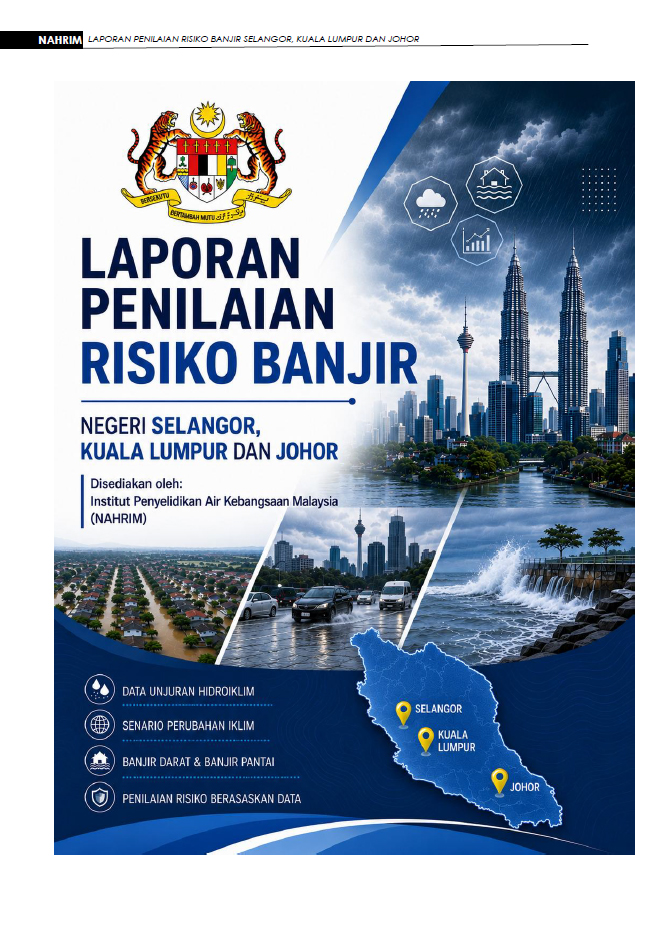
This report was prepared by the National Water Research Institute of Malaysia (NAHRIM), providing companies with localised science-based flood risk information for Selangor, Kuala Lumpur and Johor. It covers projected riverine flooding across five river basins under four climate scenarios, coastal flooding from sea level rise out to 2100, among others, to help companies prioritise at-risk assets, plan business continuity and support climate disclosures under IFRS S2.
.png)
The Aqueduct Water Risk Atlas includes baseline and future data for key water risk indicators such as water stress, riverine flood risk, coastal flood risk, and drought risk, among others.
The tool allows users to select areas on the map, conduct analysis, and upload files (.csv, .xslx, .shp) to explore risks for specific assets.
.png)
The Climate Impacts Explorer shows how climate impacts will play out over time at current emissions reductions levels (according to the scenario used by the NGFS) and in other policy relevant scenarios. It includes exposure (%) for Malaysia such as land fraction and population exposed to floods and heatwaves under different climate scenarios.
It also includes forward-looking projections of annual expected economic damage from river floods and cyclones, impact on labour productivity due to heat stress, and others.
.png)
JC3 Climate Data Catalogue (Joint Committee on Climate Change)
The data catalogue is aimed at serving as a source of reference on climate and environmental data. Click here to download the full catalogue.
TNB Scope 2 GHG Emissions
TNBX, a subsidiary of Tenaga Nasional Berhad (TNB), has developed a Scope 2 GHG Emissions Dashboard that allows preparers to retrieve historical electricity bills for up to three years. This service is subscription‑based, with different packages tailored to the size and data needs of each entity. For more information and contact details, view TNB X's presentation here.
.png)
Climate Change Knowledge Portal (World Bank)
The Climate Change Knowledge Portal (CCKP) provides national-level data for variables such as surface air temperature, precipitation, and natural disasters.
.png)
Global Resilience Index (GRI) Risk Viewer (University of Oxford)
The GRI Risk Viewer is a data and analytics portal covering hazards, exposure, vulnerability and risk to infrastructure and people. It includes key hazards (e.g. river flooding, coastal flooding, extreme heat, landslides, earthquakes), exposure (e.g. population, infrastructure, industry, buildings) and vulnerability.
Reporting to Resilience - 12 August 2026
This engagement brings together NSRF reporting entities to take stock. Following on from the NSRF Data to Disclosures (D2D) Forum held last October, the R2R Forum aims to outline reporting expectations under the NSRF, share insights from the first cohort of Group 1 companies, as well as identify tools and resources to support disclosures for companies of various sizes and maturity.
NSRF Data to Disclosures Forum – 17 October 2025
The Data to Disclosures Forum (D2D Forum) was conducted to help preparers bridge critical sustainability data gaps and strengthen their readiness to meet sustainability reporting requirements. Through panel discussions, practical demonstrations, and direct engagement with key data custodians, the D2D Forum aimed to equip participants with the tools and knowledge to access national climate datasets, leverage reporting platforms, and apply suitable methodologies that enhance disclosure quality and decision-usefulness.


