Capital Market Review & Outlook

Despite the resilience of the global economy, 2025 was marked by heightened volatility in global capital markets. In the first half of the year, uncertainties over trade policies and escalating geopolitical tensions weighed on market performance. However, as trade tensions eased and investor optimism strengthened on the back of global artificial intelligence (AI) expansion, benchmark indices in several countries climbed to historical highs. Malaysia’s capital market followed a similar trajectory, with lower trading activity in the first half of the year before rebounding later, supported by resilient domestic economic conditions despite external headwinds. Looking ahead, the domestic capital market is expected to benefit from projected interest rate cuts by major central banks, amid easing inflationary pressures and efforts to sustain growth. This is likely to spur global fund flows into emerging markets, including ASEAN. On the domestic front, the continued realisation of investment projects under national master plans, coupled with supportive policies, strong corporate fundamentals, and ample domestic liquidity, is expected to further strengthen Malaysia’s capital market in 2026.

chart 1

Global financial stress levels heightened in April 2025 amid global trade uncertainties
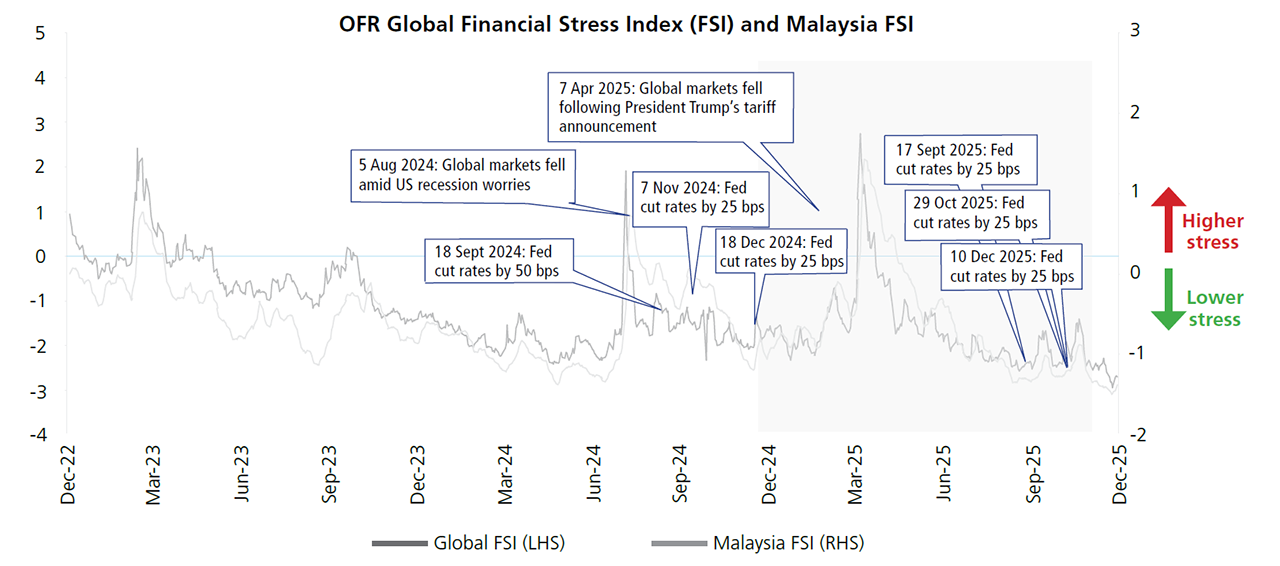
Note: The Global FSI is from the Office of Financial Research, US Department of Treasury, while the Malaysia Financial Stress Index (MFSI) is internally estimated following similar methodology (see Monin, 2017). Value of FSI above zero indicates higher than historical average financial stress in the economy.
Source: US Office of Financial Research, SC.

The global economy grew stronger than expected in 2025. According to the International Monetary Fund’s (IMF) World Economic Outlook (January 2026 update), global growth was revised upward to 3.3% for 2025, compared to 3.2% in its October 2025 projection.

The domestic economy remained resilient in 2025 amid external uncertainties arising from global trade tensions and geopolitical risks, recording growth of 5.2%. 

The global economy is expected to remain challenging in 2026 as growth is projected at around 3.3% (IMF), and ongoing global trade tensions and policy uncertainty present downside risks. Although monetary policy easing might support some sectors, trade and investment flows may still face headwinds amid this complex backdrop. Nevertheless, resilient domestic consumption in several countries should provide some support to growth.

Related Links
© Copyright Securities Commission Malaysia | Contact UsDisclaimer | The site is best viewed with minimum resolution of 1280x1024
Follow us on:
Ooops!
Generic Popup