Malaysian Capital Market Developments in 2024

The Malaysian economy exhibited robust growth in 2024, supported by resilient domestic private sector activities, the recovery in external demand and a pick-up in tourist arrivals. The labour market strengthened further, with the unemployment rate falling to its lowest level in five years, while wage growth remained favourable. By economic activity, the services sector remained as the major driver given resilient consumer spending and positive labour market conditions. Additionally, both headline inflation and core inflation moderated despite higher utilities and transportation prices following fiscal policy adjustments during the year, reflecting minimal cost pass-through effects. In 2024, real GDP expanded 5.1%, driven by a steady growth in domestic demand (Chart 3).

chart 3

The Malaysian economy expanded substantially in 2024 supported by robust domestic demand and global trade recovery

Source: Department of Statistics Malaysia (DOSM), the SC’s calculations.

The domestic capital market continued to support the real economy

The Malaysian capital market remained resilient and orderly while continuing to serve its fundamental role in enabling and facilitating capital-raising to fund the domestic economy. Malaysia's financial stress remained below its historical average1 in 2024, with the exception of the third quarter mostly due to the global market selloff in August and concerns over the US elections. The Malaysian capital market outperformed most of its regional peers despite recording net foreign equity outflows, supported by strong buying interest from several local institutional investors, stable political and macroeconomic conditions, and the recovery of the Malaysian Ringgit against major currencies.

The strong buying interest in the local bourse was followed by a slew of initial public offerings (IPOs) and the growth in the total outstanding for the bond and sukuk market, which resulted in the increase in the size of the capital market to RM4.2 trillion in 2024 (2023: RM3.8 trillion). The fund management industry expanded in 2024, with total assets under management (AUM) rising to a record high of RM1.1 trillion (2023: RM975.5 billion), driven by strong global equity market performance, particularly AI-related valuations in the US market (Chart 4). The unit trust segment remained the largest source of funds, comprising 51.1% of total AUM (2023: 51.3%).

chart 4

Size of the Malaysian capital market grew in 2024 amid higher fundraising activities, while AUM of the fund management industry breached the RM1 trillion mark

Source: Bursa Malaysia; the SC’s calculations.

Total funds raised in the capital market grew to RM138.9 billion in 2024 (2023: RM127.7 billion), of which RM14.7 billion was raised through the equity market2, while RM124.2 billion was issued through the corporate bond market. For the year, the number of IPOs increased to 55, from 32 in 2023. In line with the government’s economic policies that also focus on sustainability, the steady increase in issuances of sustainability-related instruments3 affirmed the capital market’s pivotal role in supporting financing needs. Meanwhile, the growth in alternative fundraising platforms,4 such as equity crowdfunding (ECF) and peer-to-peer financing (P2P financing), continued to promote financial inclusivity especially for micro, small and medium-sized enterprises (MSMEs).

The performance of the Malaysian equity market was largely driven by a series of domestic factors including further clarity in national policy rollouts (e.g. NIMP 2030, NETR, NSS), fiscal consolidation measures (e.g. diesel subsidy rationalisation), favourable earnings growth and corporate activities. This was further supported by Malaysia’s position in the global semiconductor value chain and numerous analysts’ upgrades on their FBMKLCI targets. Besides domestic developments, global headwinds also continued to influence investment sentiment and redirection of capital, with volatility driven by the uncertainty of the direction and pace of global monetary policy in 1H2024, ongoing geopolitical conflicts and slower economic growth from China. Notably, the foreign equity outflow from the domestic equity market amounted to -US$941.9 million in 2024, compared to a net outflow of -US$514.2 million in 2023.

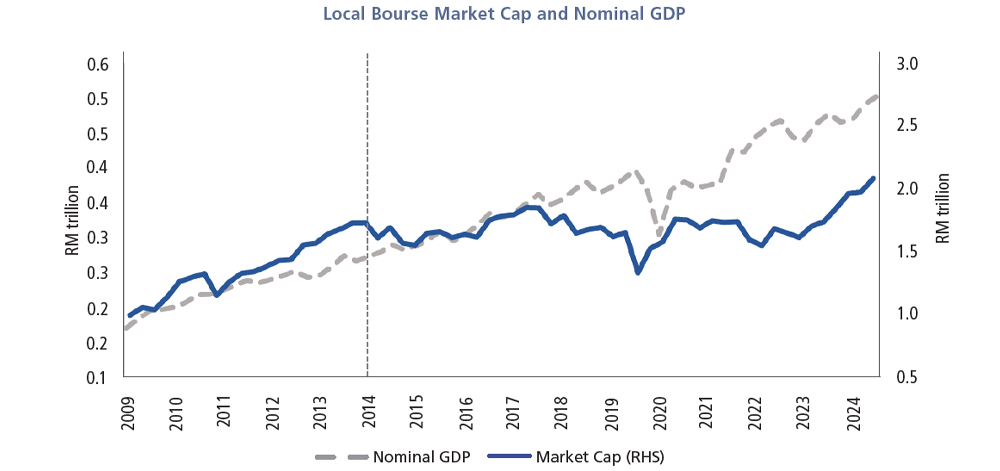
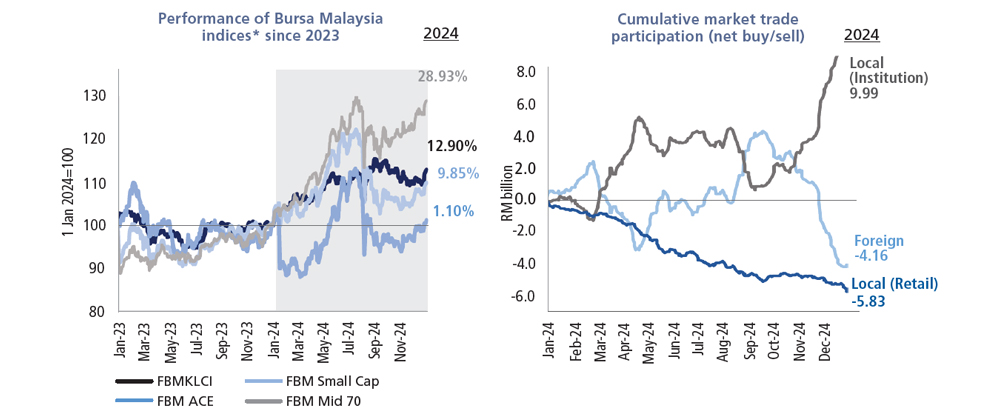
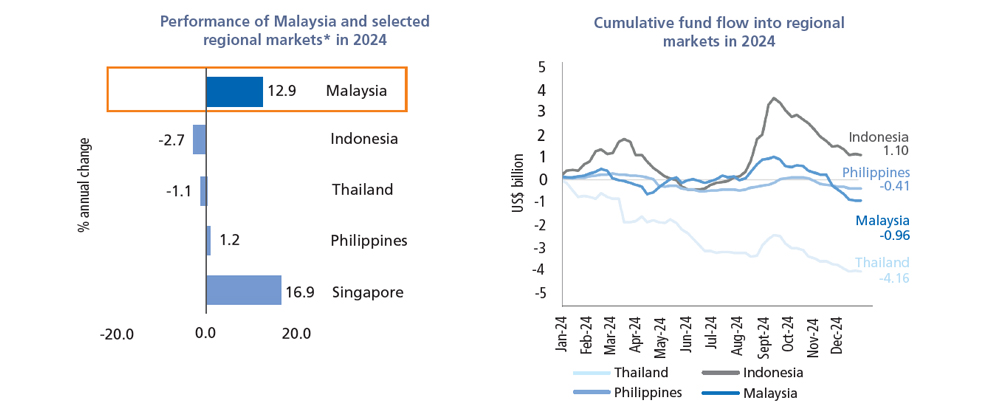
The overall market capitalisation of the local bourse ended higher at RM2.1 trillion in 2024 (2023: RM1.8 trillion), while that of the FBMKLCI rose to RM1.2 trillion (2023: RM1.0 trillion). The benchmark FBMKLCI index outperformed global and regional markets (MSCI Asia Pacific: 7.23%, MSCI ASEAN: 7.67%), rising by 12.90% (2023: -2.73%) to end the year at 1,642.33 points, while the FBM Mid 70 and FBM Small Cap rose by 28.93% and 9.85% (2023: 12.28% and 9.57%) to 18,841.13 points and 17,963.66 points respectively, displaying a positive shift in sentiment favouring medium and small-sized companies, as reflected by the favourable performances of FBM Mid 70 and FBM Small Cap (Chart 6). Notably, among ASEAN-5 counterparts, the FBMKLCI outperformed most of its peers despite recording a net outflow of funds (Chart 7). The growth in the equity market capitalisation for the year was favourable, in tandem with the pick-up in GDP growth. There continues to be a divergence in size of the capital market and GDP, but the capital market have made significant strides to narrow the gap in the past two years (Chart 5).
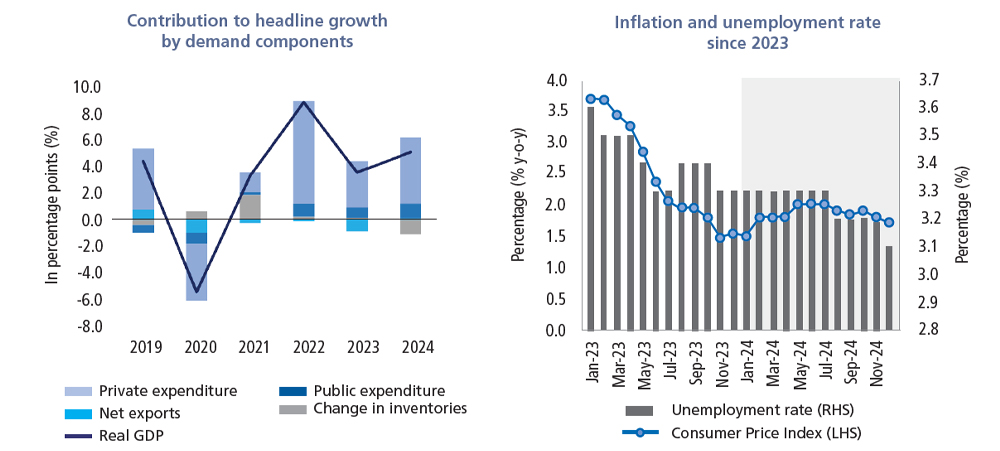
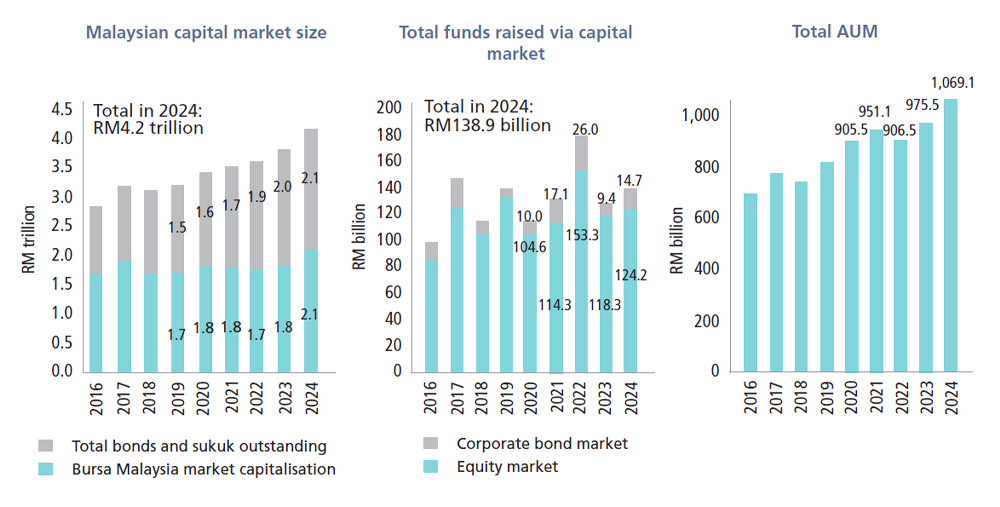
chart 5

Malaysia's equity market capitalisation and economic growth has moved in tandem over the years, while significant opportunities remain to bridge the gap

Market capitalisation represents Bursa Malaysia’s total equity market.

Source: Bloomberg, DOSM, World Federation of Exchanges (WFE).

chart 6

Malaysia’s equity market displayed growing interest toward the mid and small cap segments, while local institutions were the sole net buyers of local equities

* FBM KLCI consists of the largest 30 companies ranked by full market capitalisation in the FTSE Bursa Malaysia EMAS Index, while FBM Mid 70 encompasses the next 70 largest companies. FBM Small Cap consists of all constituents of the FTSE Bursa Malaysia EMAS Index that are not constituents of the FTSE Bursa Malaysia Top 100 Index. FBM ACE includes companies listed on the ACE Market.
Source: Bloomberg, Bursa Malaysia, the SC’s calculations.
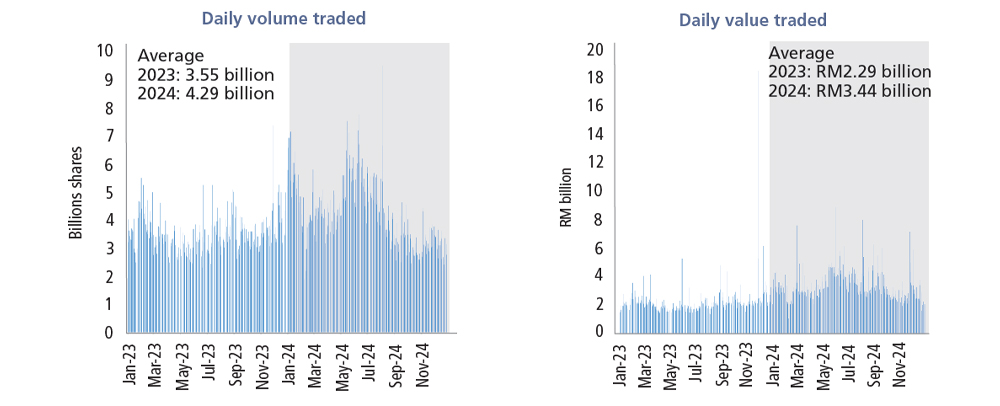
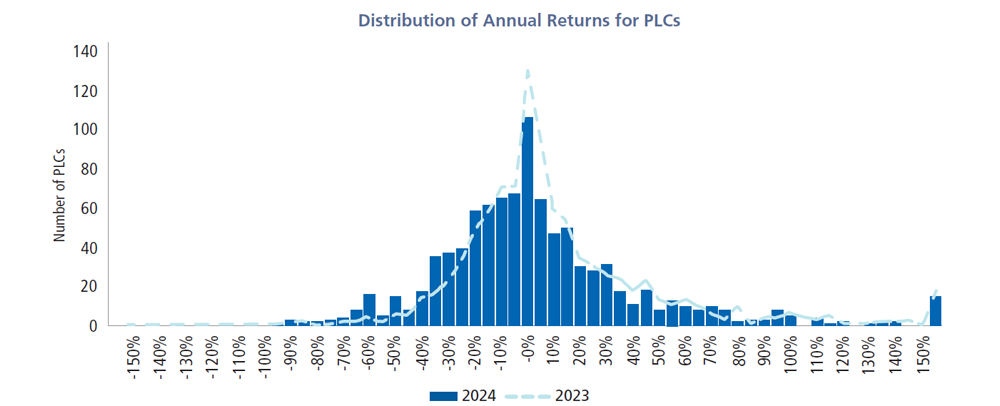
Meanwhile, the distribution of returns of the total equity market suggested that the equity market was able to provide diverse return potential for investors (Chart 10). In 2024, a total of 38 stocks recorded an annual return of more than 100%. These stocks were mostly from the FBM Small Cap and the FBM ACE Index, and majority are from the industrials and information technology sectors. This suggests that the market provides good investment opportunities and favourable returns especially to those with sound market understanding. Non-residents remained net sellers of Malaysian equities, amounting to a total of -RM4.16 billion in 2024 (2023: -RM2.34 billion), while local retail investors sold -RM5.83 billion (2023: -RM0.96 billion). Notably, local institutional investors accumulated a sum of +RM9.99 billion in 2024 (2023: +RM3.30 billion) (Chart 6). Despite a net sell position, the participation rate for foreign investors rose to an average of 35.77% in 2024 (2023: 28.41%), highlighting the appeal of the domestic equity market to non-residents. Trading interest on equities improved significantly with the average daily trading volume at 4.29 billion units in 2024 (2023: 3.55 billion units), and at a higher average value of RM3.44 billion per day (2023: RM2.29 billion), reflecting favourable investor sentiment (Chart 8).

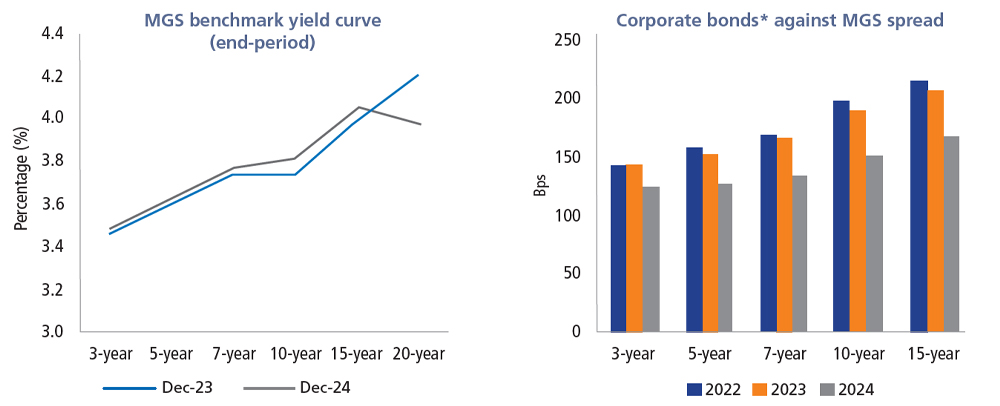
In the Malaysian bond market, total bonds and sukuk outstanding grew to RM2.10 trillion (2023: RM2.01 trillion), underpinned by the continued issuance of bond and sukuk, particularly government bonds. The overall Malaysian Government Securities (MGS) yield curve shifted slightly upward across most of the tenures during the year, except for 20-year notes, tracking the movement of the global bond market. This was mainly driven by the global economic and political uncertainties as disinflationary progress slowed in the US and elections took place in several countries. The spread between corporate bonds and MGS also narrowed across all tenures, mostly supported by the optimism on domestic economic performance (Chart 9). Meanwhile, participation of foreign investors moderated in the domestic bond market, with net inflows amounting to +RM4.78 billion in 2024 (2023: net inflows +RM23.65 billion).

chart 7

The benchmark FBMKLCI outperformed most of its regional peers in 2024, despite recording net fund outflows from the Malaysian equity market

Note: * Referenced composite indices: Malaysia – FBMKLCI; Indonesia – JCI; Thailand – SET; Philippines – PCOMP; Singapore – STI.
Source: Bloomberg.

chart 8

Equity daily trading volume and value improved in 2024, reflecting favourable investor sentiment

Note: Daily trading values and volumes are inclusive of off-market transactions. The abnormality on 29 November 2023 was due to RM16 billion in off-market transactions between CelcomDigi related entities.
Source: Bursa Malaysia, the SC’s calculations.

chart 9

Equity daily trading volume and value improved in 2024, reflecting favourable investor sentiment

Note: * Corporate bonds rated between AAA and BBB.
Source: Bloomberg, Refinitiv Eikon Datastream, the SC’s calculations.

chart 10

The distribution of equity returns provides diverse opportunities for investors

Source: Bloomberg, the SC’s calculations.

  1. Long term average: 0.00.
  2. In the equity market, RM7.4 billion was raised via 55 IPOs and RM7.3 billion through secondary fundraising.
  3. Issuances of sustainability-related instruments was RM13.3 billion in 2024 (2023: RM8.7 billion).
  4. Funds raised via ECF and P2P financing was RM2.6 billion in 2024 (2023: RM2.2 billion).
Related Links
© Copyright Securities Commission Malaysia | Contact UsDisclaimer | The site is best viewed with minimum resolution of 1280x1024
Follow us on:
Ooops!
Generic Popup