Headwinds from global economic uncertainty and trade tensions continued to shape both international and domestic financial and capital markets throughout 2025. Although greater clarity on US tariff policies lifted investor sentiment, the Malaysian capital market remained vulnerable to uncertainties over future trade developments, their eventual impact, and the path of US monetary policy, all of which could spill over into the domestic capital market. Against this backdrop, the SC maintained heightened vigilance to proactively identify and manage potential vulnerabilities to the systemic stability of the domestic capital market.
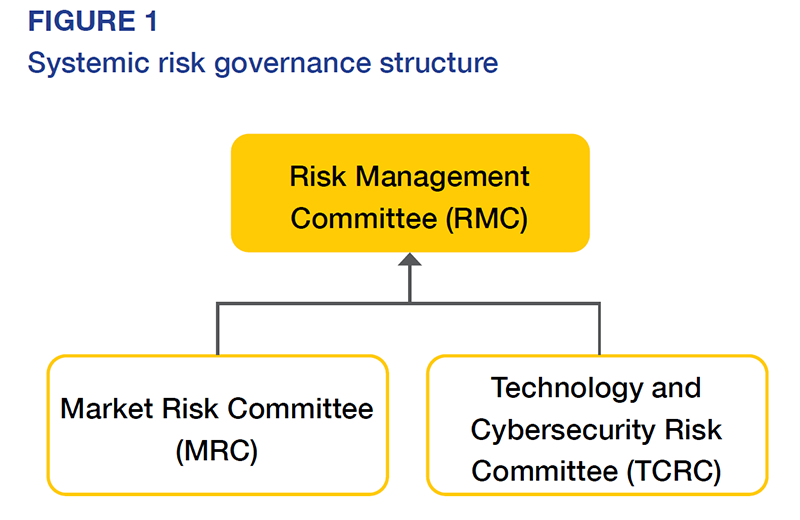
This year, the SC has strengthened its enterprise-wide risk governance framework to enable a more streamlined and structured approach in managing systemic risks. To enhance the efficiency and effectiveness of risk oversight and decision-making processes, the SC has consolidated its two risk committees – the Systemic Risk Oversight Committee (SROC) and the Executive Risk Management Committee (ERMC) – into a unified committee now known as the Risk Management Committee (RMC). Regular RMC meetings were held to address potential risk concerns emerging from various segments of the capital market that could contribute to build-up of systemic risk concerns. The RMC is supported by the Market Risk Committee (MRC) and the Technology and Cybersecurity Risk Committee (TCRC) (Figure 1).
Mitigating Systemic Risks And Promoting Financial Stability
Enhanced Risk Governance Framework
In 2021, the SC-wide risk governance framework was enhanced as part of an overall initiative to have an effective integrated and predictive risk surveillance to maintain regulatory agility.
The structured risk governance framework integrated the wider spectrum of risks such as technology, cyber and conduct risk at the SC’s Systemic Risk Oversight Committee (SROC) and Accounting, Market and Corporate Surveillance Committee (ACMS).
Intensified surveillance
The SC continued to intensify its surveillance of systemic risk to maintain market resilience and stability. Regular SROC engagements were held to deliberate concerns emanating from various segments across the capital market. Domestic equity and bond market, foreign fund flows and trade participation continued to be monitored closely for potential stress points.
In addition, measures and economic stimulus packages introduced by the government to weather the impact of COVID-19, market trading conduct and the financial position of listed companies were among the focus areas for discussion.
Thematic assessments
The SC also conducted thematic assessments covering investors’ fund flows, the position of firms, and policy decisions to ascertain the possible impact on the capital market. In 2021, the SC reviewed and enhanced its crisis indicators on potential emerging risks in the
capital market.
The enhanced crisis indicators provided a reference point for escalation to SROC when the identified indicators and triggers materialised and ensured prompt response to manage and prevent any issues of concern that might lead to a systemic crisis.
Joint regulatory discussions
In 2021, the SC conducted frequent joint regulatory discussions with other authorities such as Bank Negara Malaysia (BNM) and Labuan Financial Services Authority (Labuan FSA) to identify systemic risk concern areas within the financial and capital markets in Malaysia.
Monitoring of various components of the capital market
The SC continued its efforts to undertake a methodological and integrated approach to ensure any potential systemic risk was being monitored, mitigated, or managed. Figure 1 highlights the findings from the following risk assessments on the various components of the capital market.